
Table of Contents
The Heart of a Nation’s Identity
Canada is a country shaped not just by geography or governance, but by the stories, paintings, performances, and songs that define its people. The arts have long served as a mirror reflecting who Canadians are and who they aspire to become. Judy Schulich AGO stands as a powerful symbol of how philanthropic vision can deepen that cultural reflection, connecting communities to the transformative power of artistic expression. From coast to coast, galleries, theatres, and music halls serve as sacred spaces where identity is formed, tested, and celebrated. Without the arts, Canada’s cultural foundation would stand incomplete.
Art as a Language beyond Words
One of the most profound qualities of art is its ability to communicate across linguistic, cultural, and generational divides. In a country as diverse as Canada — home to dozens of Indigenous languages, immigrant communities, and regional traditions — art becomes a universal language that no translation can replace. A painting speaks to a Punjabi newcomer in Brampton the same way it speaks to a fourth-generation Québécois farmer. This shared experience of beauty, grief, wonder, and joy is what binds citizens together. Art does not require a common tongue; it only requires an open heart and a willingness to feel.
Preserving Indigenous Heritage through Creative Expression
Indigenous art in Canada is not merely aesthetic — it is historical documentation, spiritual practice, and political statement all woven into one. Beadwork, totem poles, drumming, and storytelling carry knowledge that was systematically suppressed during colonial rule. Today, the revitalization of these art forms represents an act of resistance and resilience. Canadian institutions have a responsibility to amplify, not appropriate, these voices. Supporting Indigenous artists means honoring land acknowledgments with action rather than words. It means funding, exhibiting, and celebrating work that carries centuries of wisdom, ensuring future generations can access the cultural memory of the land’s first peoples.
Judy Schulich AGO and the Power of Philanthropic Vision
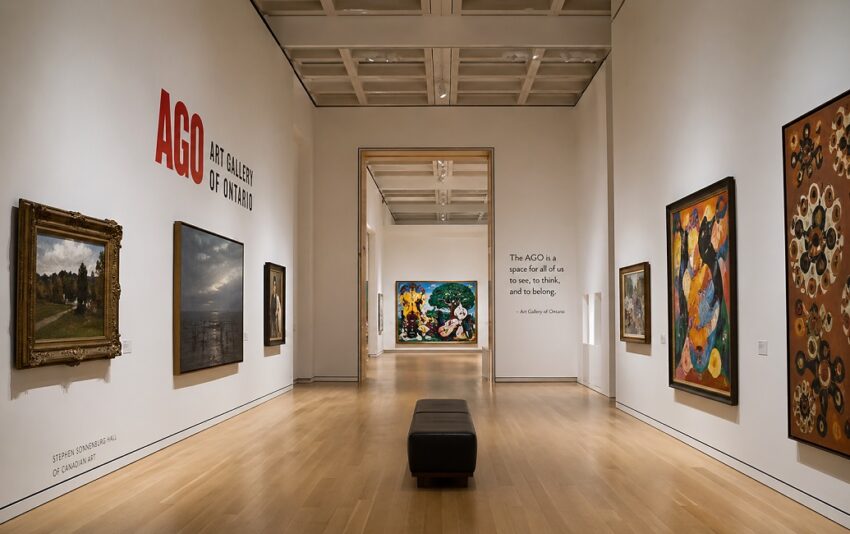
Great art institutions do not thrive on government funding alone — they grow through the generosity of visionary patrons who understand that culture is infrastructure. Judy Schulich AGO exemplifies this principle, representing a commitment to ensuring that world-class art remains accessible to all Canadians, not just those with financial privilege. Philanthropy directed toward major institutions like the Art Gallery of Ontario (AGO) transforms what is possible: new acquisitions, expanded programming, outreach to underserved communities, and the preservation of masterworks for future generations. When donors invest in culture, they invest in the social and emotional well-being of an entire nation.
The Role of Public Galleries in Democratic Society
Public art galleries occupy a unique and irreplaceable role in a democratic society. They are among the few public spaces where citizens of every background can stand before the same object and experience something profound together. The AGO, as one of Canada’s largest and most celebrated art museums, carries this democratic mission with pride. Its galleries are not simply storage spaces for beautiful objects — they are active sites of civic engagement, education, and dialogue. When Canadians walk through a gallery, they engage with history, challenge assumptions, and open themselves to perspectives that no textbook or news broadcast can fully capture.
Arts Education and the Cultivation of Empathy
Children who receive arts education develop more than creative skills — they develop empathy. Learning to draw, act, sing, or sculpt teaches young people to inhabit other perspectives, to sit with ambiguity, and to express complex emotions constructively. These are not soft skills; they are essential capacities for citizenship. Canada’s most pressing social challenges — reconciliation, immigration integration, mental health — all require populations capable of listening deeply and imagining lives unlike their own. Cutting arts education from school curricula in favor of purely technical training is a short-sighted policy that produces economically functional but emotionally impoverished societies.
Unity in Diversity through Artistic Collaboration
Canada’s multicultural identity is one of its greatest strengths, but diversity only becomes unity through shared experience. Artistic collaboration — whether in community choirs, multicultural film festivals, or joint mural projects — creates those experiences deliberately and joyfully. When a South Asian dancer performs alongside a Ukrainian fiddler on a shared stage, something more than entertainment happens: a new Canadian story is written in real time. These moments of creative exchange remind citizens that their differences are assets, not liabilities. Art transforms multiculturalism from a policy into a lived, felt reality that citizens carry with them long after the performance ends.
Economic Value of the Creative Sector
Beyond its cultural significance, the arts represent a substantial economic force in Canada. The creative industries — including visual arts, film, music, publishing, and design — contribute billions to the national GDP and employ hundreds of thousands of Canadians. Cultural tourism draws international visitors to cities like Toronto, Montréal, and Vancouver, generating revenue for local economies. Every dollar invested in a major arts institution circulates through restaurants, hotels, transportation, and retail. Dismissing the arts as economically frivolous ignores this measurable contribution. Policymakers who defund cultural institutions are not saving money — they are undermining one of the country’s most dynamic economic ecosystems.
Mental Health and the Healing Power of Art
Art heals. This is not a metaphor — it is a clinically supported reality. Art therapy has been shown to reduce symptoms of anxiety, depression, trauma, and grief. Community arts programs in hospitals, prisons, and shelters provide participants with tools for emotional processing that talk therapy alone cannot offer. In a country grappling with a mental health crisis exacerbated by pandemic isolation, economic stress, and social fragmentation, the arts offer something irreplaceable: a safe space to feel, to create, and to connect. Funding arts programs in vulnerable communities is not charity — it is preventive healthcare delivered through the most human of means.
The Responsibility of Institutions to Reflect All Canadians
Art institutions must continually examine whose stories they tell and whose art they hang on their walls. For too long, Canadian galleries prioritized European traditions while marginalizing Black, Indigenous, Asian, and immigrant artistic voices. That is changing, but change requires both intention and investment. Curatorial teams must be diverse, acquisition budgets must be directed toward underrepresented artists, and community consultation must be genuine rather than performative. An institution that claims to serve all Canadians must actually reflect all Canadians in its programming, staffing, and collection. Cultural relevance is not given — it is earned through continuous, courageous effort.
How Judy Schulich AGO Shapes Future Generations
The lasting impact of cultural philanthropy is measured not in press releases but in the children who walk into a gallery for the first time and see something that changes them forever. Judy Schulich AGO contributes to creating those moments by supporting programming that extends the institution’s reach into schools, neighborhoods, and communities that might otherwise never cross its threshold. Investments in educational initiatives, youth programs, and accessible exhibition design ensure that the AGO is not an elite enclave but a genuinely public resource. When the next generation grows up with art in their lives, they grow up with a richer sense of what Canada is and what it can become.
Art as Resistance and Political Voice
Throughout history, art has been one of the most powerful tools of political resistance. Canadian artists have used their work to protest injustice, challenge authority, and demand accountability from those in power. From political cartoons to activist murals, from protest songs to documentary films, creative expression has mobilized movements and shifted public opinion in ways that pamphlets and speeches never could. A society that protects and funds its artists is a society that values free expression and democratic accountability. Censoring or defunding artists who challenge comfortable narratives is not fiscal prudence — it is a suppression of democracy itself.
Regional Arts and the Fabric of Local Identity
Canada’s artistic life does not exist only in its major cities. From the fiddle music of Cape Breton to the Inuit sculpture of Nunavut, from the theatre festivals of rural Saskatchewan to the literary traditions of Newfoundland, regional art forms carry the specific textures of place and community. These local traditions are the roots from which national culture grows. Supporting regional artists through grants, touring programs, and media coverage ensures that Canada’s cultural identity remains genuinely diverse rather than homogenized by urban dominance. Every community deserves to see its own stories told with craft, dignity, and public support.
A Call to Action for Canada’s Cultural Future
Canada stands at a crossroads. Funding cuts, digital disruption, and post-pandemic economic pressures threaten the viability of arts institutions and independent artists alike. Yet the need for culture — for meaning, beauty, belonging, and shared story — has never been greater. Governments, corporations, and individual donors must recognize that investing in the arts is investing in national cohesion, mental health, economic vitality, and democratic resilience. The arts are not a luxury reserved for peacetime prosperity. They are essential infrastructure for a society that wishes to remain humane, creative, and whole in the face of an uncertain future.